


Clipping campaigns run on a simple promise: partners pay for real views. Botting breaks that promise twice over — it siphons budget into fake engagement, and it corrupts the analytics partners use to plan every campaign that follows.
In our experience, the share of botted views varies enormously from campaign to campaign — from effectively zero with hand-picked, vetted creators to as much as 90% in the worst cases we've measured. For a typical open campaign, 10-50% is a realistic band. Numbers like these are no accident — the economics of fraud are simply favorable:
- View counts can be inflated cheaply through ad arbitrage — buying low-CPM ad inventory in markets with no relevance to a campaign's target audience (e.g., Southeast Asian inventory for a campaign targeting US audiences).
- Commercial botting services imitate the shape of legitimate engagement curves for as little as $0.06 per thousand views — against clipper rewards of $1-3 per thousand views, that's a 16-50x return on every uncaught dollar.
That's why we at Evangelist treat fraud detection not as an optional feature, but as the foundation our whole platform stands on.
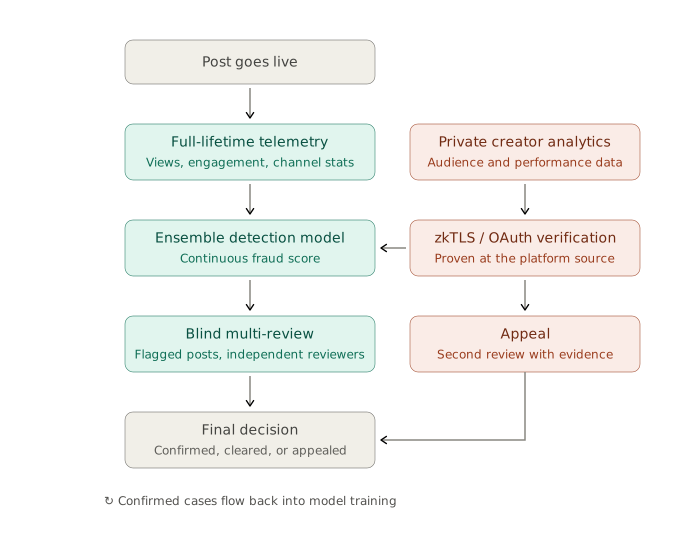
Our approach rests on two observations. First, fraud has two surfaces: you can fake engagement on the social media platform itself, or you can fake what gets reported about it. We built a separate line of defense for each — and designed them to cover each other's blind spots. Second, fraud detection is an arms race, not a solved problem: adversaries adapt to whatever defenses they encounter, so a detection system is only as good as its capacity to keep learning.
Pillar One: Detecting Fake Engagement
We watch the whole lifetime of a post, not a snapshot. Views, likes, comments, and channel statistics are tracked with high granularity from the moment a clip goes live. Botted growth doesn't just inflate total numbers — it evolves differently than organic growth, and those differences only become measurable when the full time series is recorded.
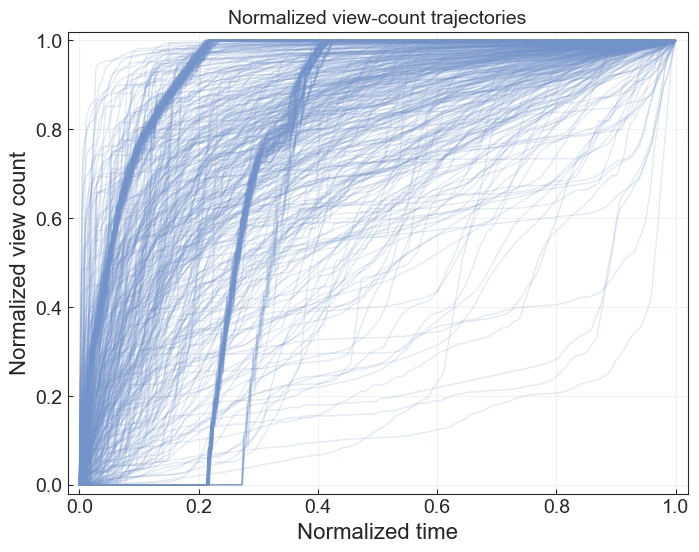
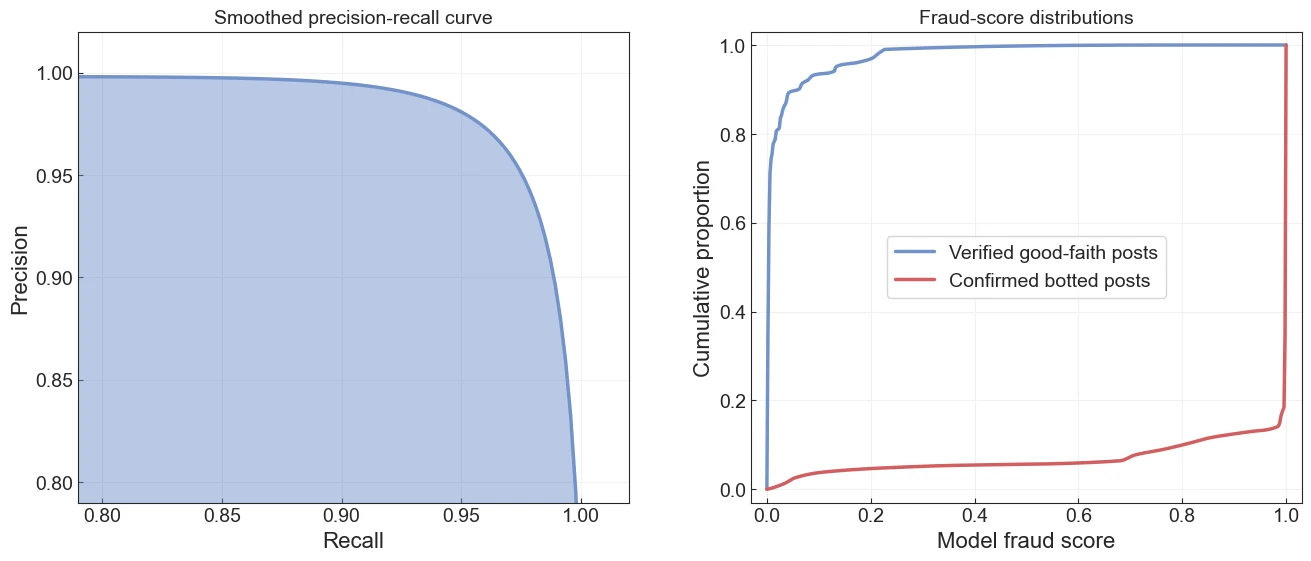
We use particle-physics-grade detection. Every post and every data point passes through an ensemble of models built on the same class of machine learning techniques used at CERN to isolate rare particle decays hidden in billions of collisions. Instead of decays, the ensemble searches a high-dimensional space of engagement patterns for fraud signatures — subtle, correlated anomalies that simple thresholds, and often human inspection alone, would miss. The output is not a binary verdict but a continuous score, which lets us tune the operating point between precision (the fraction of flagged posts that are genuinely fraudulent) and recall (the fraction of fraud we catch). Concretely, we optimize an importance-weighted Fβ score: β encodes how much weight recall carries relative to precision, and importance weighting ensures the posts with the most at stake count the most.
Note that we operate on a different layer than traffic-side verification: we never see requests, IP addresses, or device signals — those belong to the platforms, whose own filtering already removes most commodity invalid traffic (what the media industry calls GIVT) before it ever registers as a view. What reaches our system is, by definition, the harder problem: activity sophisticated enough to have already passed a platform's defenses — SIVT, in industry terms. At the metrics layer, that fraud has exactly one place left to hide — the shape of engagement itself — and that is where the ensemble hunts.
We engineer the human element. Human review is where fraud detection in this industry is traditionally weakest: reviewers can be biased, fatigued, or compromised. Some fraction of flagged cases will always require human judgment, so rather than treating review as an afterthought, we secure it by design. Reviews are blind — reviewers assess the behavioral data without being able to identify the post or the channel behind it, which removes bias along with the possibility of being pressured or bought. Multiple reviewers independently rate the same post, and reviewer performance is measured on two separate axes. Accuracy is scored against ground truth: cases with known labels — including botting we commissioned ourselves — are seeded into the review queue, so we know how often each reviewer is right when the truth is known. Integrity is monitored statistically: decision patterns are continuously analyzed for systematic effects such as leniency toward particular channels, drift over time, or even rating more generously late on a Friday afternoon — and anomalous patterns trigger a review of the reviewer, not automatic penalties.
The system learns. A detection model is only as good as its ground truth, so we curate ours from three deliberately different sources. First, a periodic random sample of posts — drawn independently of anything the model flagged — is adjudicated by multiple independent reviewers working from each post's full behavioral record; random sampling keeps the system from confirming its own biases and lets us estimate real-world error rates. Second, we manufacture our own fraud, commissioning botting on our own test posts from commercial services we identify in the wild — current, real-market techniques with labels we know are correct. Third, posts from good-faith creators vetted independently of the model — hand-picked for closed campaigns, with long track records and cryptographically verified analytics — serve as verified clean examples, anchoring the false-positive rate. Confirmed cases from all three streams flow back into training, and every retrained model is benchmarked on temporally held-out, channel-disjoint data before it goes live. Catching fraud matters; not flagging honest clippers matters just as much.
Pillar Two: Verifying What Gets Reported
Observable metrics are only half the battle. The other half is private creator analytics — demographics, audience breakdowns, and performance data that cannot be collected publicly and that clippers present to justify payouts. Today, the industry standard for such a “proof” is usually an unverified screenshot or screen recording, which can be doctored in minutes, generated by a modified app, or produced by a fake replica of a platform's analytics page.
We close that gap with zero-knowledge cryptographic verification, built with a specialized technology partner. Demographics, views, and engagement are verified as they arrive from the platform's own servers, over the same secure connection (TLS) every browser already uses. The clipper cryptographically proves that the platform actually sent those numbers — without ever handing over passwords or account access. The proof is bound to the live, encrypted session with the platform itself, so it cannot be produced after the fact from an edited image or a replica app. And because the proof is zero-knowledge, it reveals only the specific facts being verified — a demographic split, a view count — and nothing else about the clipper's account. There is nothing to doctor, because no human-relayed artifact exists in the loop. Proofs are refreshed on a regular cycle, so outdated analytics can't stand in for current ones.
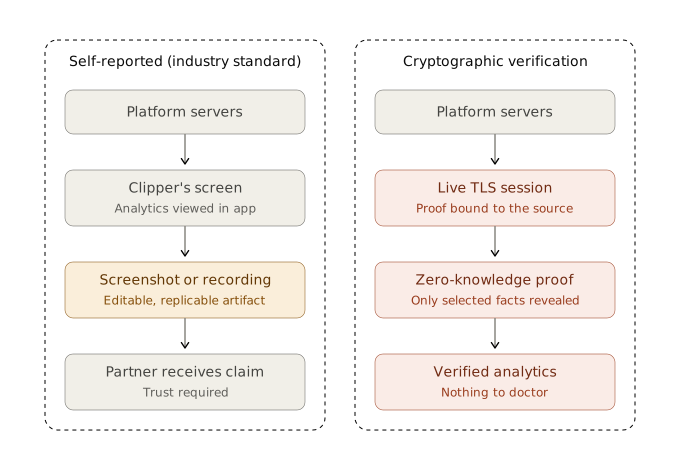
Where platforms support it, OAuth provides a complementary source of truth: clippers can grant narrowly scoped, revocable read access to their analytics, and we retrieve the same figures directly from the platform's API rather than from anything the clipper relays.
Not every creator is ready for cryptographic verification and not every partner can use OAuth. Large accounts — often agencies operating clipping at scale, whose livelihood rides on account standing — are understandably wary of granting any programmatic access, fearing platform-side flags or reach penalties. For those cases we accept a middle tier: security-managed video proofs. Unlike the unmanaged recordings dismissed above, these are recorded under constrained conditions — on a mobile device, interacting live with the real platform app — and each submission carries a real time cost for the submitter, which makes faking at scale expensive in the one currency fraudsters can't buy back. Video proofs are a bridge, not the destination: as cryptographic verification earns creator trust — precisely because it never touches credentials — we expect the ladder's top rung to become its standard.
Verification also closes the ad-arbitrage loophole from our opening. Arbitraged views are the subtlest case: real people, plausible engagement, faithfully reported by the platform — authentic in every respect except the one that matters, namely who is watching. No authenticity check can catch them, and that is the point: here verification works through the content of the proven data. A cryptographically verified view-origin and demographic split exposes the mismatch between the audience a campaign paid for and the audience it got — and when payouts are conditioned on verified target demographics, arbitrage stops being profitable by construction.
For honest clippers, the same machinery cuts the other way: the creator whose audience genuinely matches the campaign gets that value proven beyond dispute — and proven privately, with only the specific facts disclosed and no account credentials shared with us or the campaign partner.
When the System Is Wrong
No detection system is perfect, so we built the appeal process directly into the architecture — not as an exception handler, but as part of the system's feedback loop. If a clipper believes a post was incorrectly flagged, they can file an appeal and support it with additional cryptographically verified platform analytics — such as view-source information — even on campaigns that didn't require verification. An independent reviewer considers the appeal alongside the post's behavioral history before a final decision is made.
Then the loop closes. An overturned flag is a confirmed false positive — the single most instructive label a detection model can receive, and one that arrives already backed by verified evidence. Appeal outcomes flow back into training alongside our other ground-truth streams, so a successful appeal doesn't just clear one clipper: it makes the same mistake less likely for every clipper after them.
No Single Test Is Enough
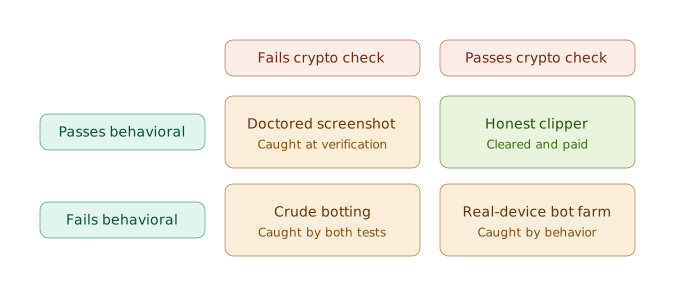
Cryptographic verification tells us whether reported analytics came from the platform; behavioral analysis, whether the activity behind them was authentic. Neither test suffices alone, but together — with human review, appeals, and continuous evaluation — they give us and our partners substantially stronger evidence to act on.
None of this makes fraud impossible. Botting is an adversarial problem: any defense that stands still is eventually mapped and defeated, so our goal is not to declare the problem solved but to keep outpacing the people working to break it — retraining continuously, benchmarking against newly identified bot operations, stress-testing our own detectors.
Herd Immunity
Detection compounds across partners. Every confirmed case — any campaign, any customer, any appeal — sharpens the same shared ensemble, so a technique caught once is recognized everywhere from that day on. This is deliberate: isolated per-partner models would let botters refine a technique against one silo and replay it, fresh, against the next. A single continuously trained system works like herd immunity — each partner is protected by attacks others have already absorbed — while only fraud signatures flow into the shared model; campaign strategy, budgets, and creator relationships stay private to each partner.
Consequences compound as well, because detection alone doesn't make botting irrational — a botter who merely forfeits one payout can simply try again. Confirmed fraud therefore follows the creator, not just the post: it raises scrutiny on everything they submit and, for repeat offenders, ends their access to campaigns. We are building toward creator-level trust scoring and, ultimately, fraud-signal sharing across connected clipping platforms, so a ban in one place is not an invitation to move to the next. Fewer fraudulent clippers means cleaner metrics; cleaner metrics mean partners can trust what they're buying; and that trust draws larger budgets into clipping. Fraud detection done well doesn't just protect campaigns — it cultivates the ecosystem every clipper, partner, and platform depends on. That's what we're building at Evangelist.